
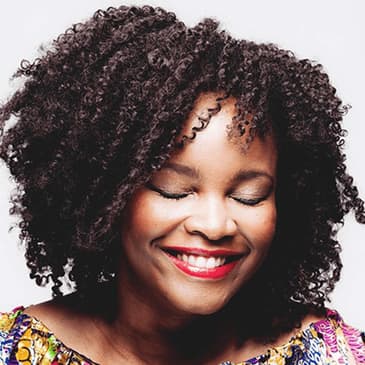
Welcome to the third season of Hyphenated: Music + Identity.
As noted in the teaser, I decided than rather than try to hold to schedule -- never worked -- I'm going to be dropping episodes sporadically as they are done. But I'll say that I'm very excited about all the artists that have so far agreed to participate this season, and I'm sure you will be too.
Selma Oamusse was born in the middle of the civil war in Mozambique, but at the age of six, her parents moved to Portugal. But when the war was over, and her parents decided to move back, Selma, at 14 years old, felt more Portuguese than Mozambican and convinced her family to let her stay on until she finished high school, She pursued a career in engineering, but after joining a church choir, music became a vehicle for her to understand how the post-colonial mentality had shaped her identity. Music also became more than a career, it became a mission -- a mission to promote Mozambique, a mission as a mother, a mission of spirituality, of social activism, and a means to bring joy and healing to others through music.
Please like and subscribe. Also, consider buying some of today's artist music or adding them to your streaming playlist. Or better yet, go see them play live. A playlist of music in this episode, transcript, as well as links to more information about the artist, can be found at our website http://www.hyphenated.eu. It's also where you can find other episodes and discover more hyphenated artists. And if you'd like to support this series, please tell a friend.





TRANSCRIPT
Hi, I am Selma Uamusse. I consider myself as a musician. In Portuguese, it's musica, which is very beautiful. So I'd rather say that I'm a musician, then just a singer. I'm 44 years old. I have four girls. And I'm from Mozambique, but I live in Portugal since I'm six years old. I was living here with my parents, but then when I was 13-14 years old, they went back to Mozambique. And that was when I decided to live in Portugal by myself. And I became first an engineer, but then I discovered music and the magic. people's heart.
I haven't done romantic songs because I don't think that that's what I have to give to the world, not because I don't love, but what I want to give to the world are healing songs that bring joy, that make you think. So I remember when I first had to decide, should I do do music or not, should I just be an engineer? I was giving a concert and this couple, they always came into my concerts and they said like, “Oh, Selma, we're here to see you, but this is the last concert that we're coming. We're no longer a couple, but because you always knew us as a couple and we bought tickets before, we wanted to tell you that we're separating.” And then I don't know what I sang, but in the end, they told me, “Okay, this was very beautiful and very powerful. So we decided that we were going to give another chance to our relationship.” And then they got married and then they have children.
And to know that maybe just because of a song that touched their heart that they could start over again. So yes, definitely. Music is super powerful, but super therapeutic and healing. And so for me, I tell this story because it actually changed the decision of becoming a full-time musician.
So I perfectly remember the first time I was in Portugal. That was in 1986, because I was four years and a half. And I was actually kidnapped, and that's something very strange. In a flea market by this, I think they were gypsies. They kidnapped me because there weren't many black people in Portugal by that time and in this village. And so they thought I was a lucky charm. And my mother was desperate looking for me and they had to call the police. And eventually they found me. And then the woman that took me, she was like, “Oh, but she's, she's so pretty that we want her for having good luck” and all that. So it was very, very awkward, very strange. And very disturbing also. Yeah, not just disturbing for being kidnapped, but for understanding how ignorance can hit people, make people do very strange things, and it was more about a lesson on the importance of not being ignorant.
But I also remember things from Mozambique, the family meetings, my grandfather dancing, and the gatherings of people dancing and singing or playing in the middle of the summer and the rain, like this hot rain. But Mozambique was in a civil war until 1992 with the peace treaty and all that. And we lived Just in the corner with this military base. There was lack of food. Sometimes we didn't have light or water, but we actually didn't see war happening. But I can remember the smell... the smell of the blood mixed with the earth. So I remember like these big cars with soldiers inside, several times smelling like blood.
But then my parents decided to move, both of them, when I was six years old to Portugal. My mother got a master's degree scholarship. And my father, he was already, lived in German, and changed his university to Portugal. But because their goal was never to be immigrants. They always wanted just to graduate and go back to Mozambique. So it was never on the plans to stay here more. So they went back to Mozambique in 1997. And I went back to Mozambique with them. At a certain point, I felt that I could adapt, but I didn't identify myself with the other kids. So I told this to my parents. I said, like, “Okay. Like, I'm a teenager. I love my friends. I like it here, but I cannot identify it with these kids. (They were totally different from me, or they were very privileged.) So please let me go back to Portugal and finish high school. And when it's time for university, then I'll decide if I want to go to South Africa or to stay in Mozambique.” So I was very responsible and I was a very good student. So I convinced them by that, I told them, like, “I'm going to behave very well. I'm going to keep on being the best student. And I'm going to stay with this friends, this kind of godmother.” Actually, I stayed with her just for a few months and things didn't went well. And eventually I ended up actually living by myself. But I was a very responsible teenager. So I became independent very early. They kind of trusted that it would be okay. And it turned out, and it turned out very well.
Well, as a teenager – and actually in my early young adult life, I kind of felt as a pariah. Because in Mozambique, I was too Portuguese to be a Mozambican. And in Portugal, I was always very Mozambican to be Portuguese. I think that what prevails the most in my way of being is Portugal, because I grew up with white Portuguese, high middle-class people. And I was always the only black girl at school until university. And my parents also weren't here, so I didn't have much contact with Mozambican community.
Portugal has a colonization history background. So when we talk about colonial mentality, colonial mentality is something super hard to take out, for us to make the shift. And Mozambique was a colony of Portugal for 500 years. And there are lots of black people that were born in Portugal and they never went to Africa.
So a friend of mine, she was saying like, “My children, they're black, but people keep on asking them, where are they coming from.” And they were never in Africa and they will always assume that because they are blacks, that they're not Portuguese.
But having another kind of culture inside of you, it's super hard to dismantle it. So that's why I think that most of us struggle with recognizing structural racism, recognizing as black African people, recognizing our places of empowerment, if it's something that we are really doing for ourselves, or if it's something that we deserve or not, it's still a struggle on the colonial mentality that told you that you were less than the colonizer. You didn't deserve to speak in your own languages because your languages and your culture meant stupidity, meant that you were a savage or just didn't lead you to have a social and economic status that you could have if you embrace the colonizer culture.
So for me to take off those layers, it took a long time. It took me to university to understand that I didn't have to prove that I deserved things, that I could just be me. But before that, I thought that I was just being me. So I never felt in a cage or something. But looking back, I can understand how my social behavior of being very sweet, of being friends with everybody, like having this always pleasing everybody complex, which is something very colonial.
I think it was only when I started singing, when I was 18-19 years old, that this awakening for my Mozambique-ness came. I started singing in the gospel choir, where the African community was bigger. So it was nice. So I started having more connection with other people from former colonies – Angola, Cape Verde, Mozambique, etc. And I'm kind of like, “Yeah, I'm home. I feel like I'm at home.” Then I started to sing in a rock and roll band. And kind of my role in this rock and roll band was like the “soul girl.” So my role was really like to have like all this wild EYAAH!. And then I started to lots of things like this Afrobeat band. and I was always looking for the things that were more African in terms of sonority and all that. And I just felt it was so true. It was like something that I was never so exposed to. Then suddenly it seemed so right. And so I think that that's how this all started.
And so this happened also with the music that I made when I decided to give my first steps as a solo artist, because I already knew people from the industry, from labels. And people were like, “Why are you doing that music, like that weird music? Why don't you do like this soul project or this rock project?” Everybody was trying to tell me what to do. And that was when I kind of gave my yell of freedom. And I said, “No! I'm going to do whatever the hell I want! Even if you don't understand, even if it's weird, even if it's not very commercial, even if I'm not going to have the support of an important label.” And so that meant doors closed, but also it meant my identity recovered. So I felt very free when I started to explore the Mozambican poly-rhythms, the Mozambican traditional instruments. Not only because I was going there, but also because I was fusing and mixing with the layers that, of course, I already had from jazz, from rock, from gospel, but I could be myself. And even if it didn't work, I was pretty happy on doing that. And that's how I found out that I was still encaged. And when I started feeling free with other decisions, and when I understood that I have to do this for my own sake, I became a lot happier.
Yeah, music as a mission is like my way of being in such a hard business, because it is a business and of not seeing it as a business. It is a place of joyfulness. It is a place of accomplishment. It is a happy place of art. Also, because it comes with a social role that I'm not just a musician, but I always use my music to bring social awareness on so many different subjects. But it would not endure if I didn't see it as a mission. A mission of bringing Mozambique to a different level of knowledge.
Mozambique was always known as a poor country, as the country of the war, of corruption, of the floods, of the drought. So whenever I travel, whenever I do things, it's also kind of in this patriotic – without being nationalistic – way of bringing my country to a different kind of fame. And so one of my first missions is to bring the name of Mozambique known for other reasons.
And then music as a mission, choosing to follow a profession that not being easy, I take it very serious. Well, music is sacred. Music is sacred. It brings us to a level of experiencing ourselves, and knowing in a way that, I think few things take. I'm thinking about songs that have changed my life, that make me cry, that make me dance, that make me want to change things in me, but also make me want to change things in the world. So music is super and something that it's powerful when it's well used. It, it heals. So it is a therapy.
And that happened especially when I became a mother for the first time. So it is a mission also as a mother to be consistent and to be the best musician that I can be as an example for my children.
Mission as a mother, mission as a Mozambican, and also mission as a believer for my spirituality.
I do love making people feel visible. I think we live in a world where people don't feel visible, they feel that no one is looking at them, and they feel that the artists are there – and that you are here. And so that's why I always make this movement of the going in the middle of the crowd and to actually look in the eyes and to hug and to connect. That's really important for me. So it's a mission in many layers.
You know there was a when saying “world music” as so easy, but it's so wrong these days to say “world music.” But actually, I do feel that every is world music. For me, it's like, why should we have this prejudice on what “world music” is? Should it only be music made with traditional instruments and in native languages, or should it be music for everybody? So I would like to say that I do “music for the world.” Maybe not “world music,” but at least “music for the world.” With no borderlines, with no limits. And so I want to explore everything. I want to do calm songs. I want to do crazy dancing songs.
It's really difficult for me to identify my music in a specific genre. I'm not able to do it, and I really want to make music for everybody, for the world. Yeah, for sure. I would say that the fact that I want to make music for the world, it tells a lot about who I am. I am that person. I am a person of the world, for the world, to the world. And that's how I would define my music. Mondo... Mondo-Uamusse. Amen to that.